The Challenge
Company values are easy to explain and harder to apply. A new hire's first real test usually comes later, in a messy decision where several values matter at once.
The challenge was to create something engaging enough for Day 1, but substantive enough to build judgment rather than simple recognition.
The Solution
I designed an AI-powered choose-your-own-adventure game that gives learners a safe place to practice decision-making through realistic workplace tradeoffs.
AI does not act as an evaluator. It acts as a game master: guiding scenarios, narrating consequences, and making patterns in the player's thinking more visible. That made the experience feel like play, while still targeting serious learning.
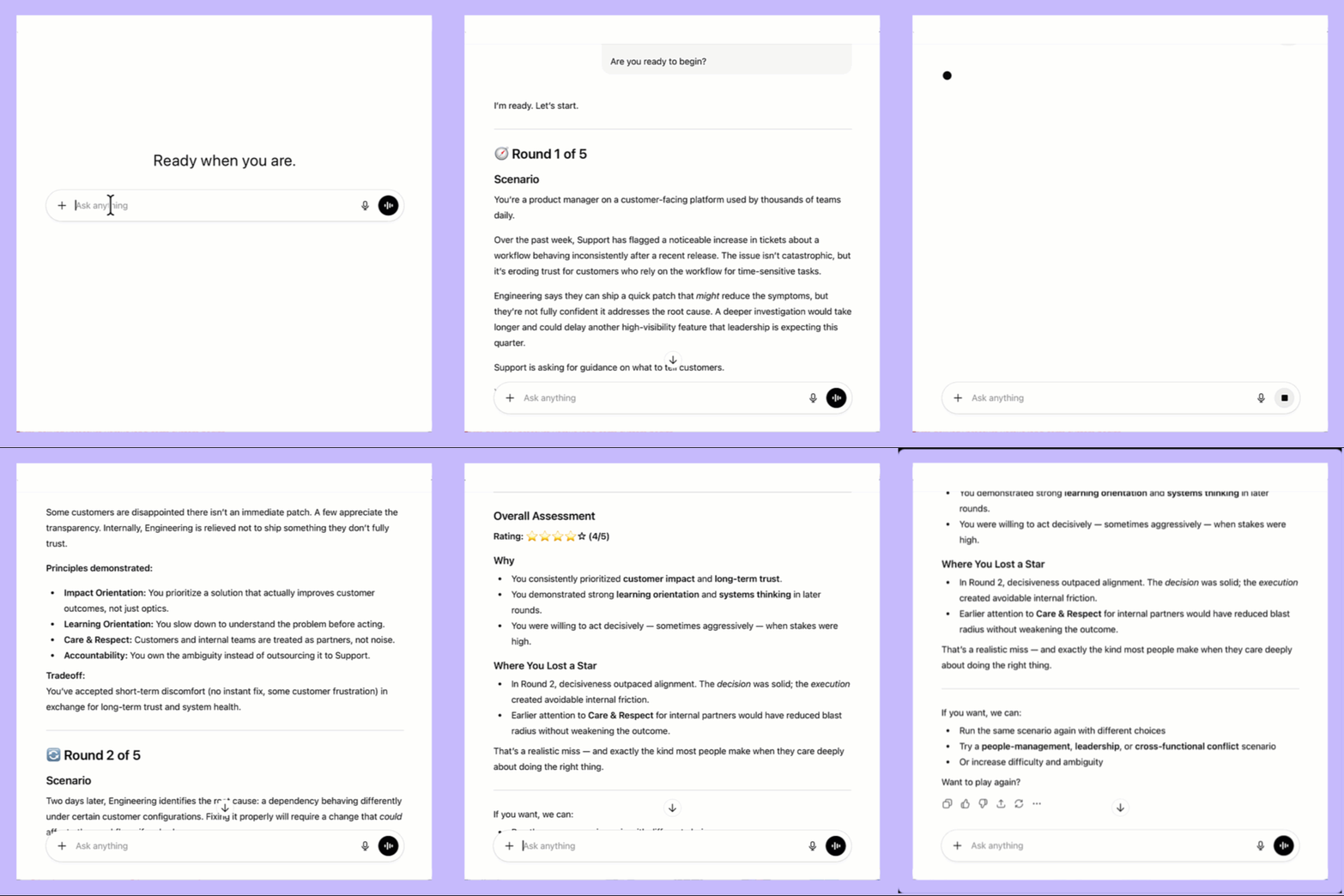
How It Works
- Players move through a fixed five-round structure built around realistic workplace dilemmas.
- In each round, they choose between plausible responses where no option is obviously right.
- AI dynamically generates the scenario details, consequences, and debrief while staying inside the learning structure.
- At the end, the system reflects back the player's judgment patterns, not just what they got "right."
Key Design Decisions
- Judgment over memorization: I designed for value conflicts and tradeoffs, not right-answer recall.
- Play over passive instruction: A game creates a lower-stakes space to explore difficult choices.
- Structure with emergence: The mechanics stay fixed, while the scenarios and narration can vary. That keeps the experience both reusable and fresh.
- Reflection over evaluation: The goal is to surface how someone is thinking, not just score them.
Reusability
One of the most interesting outcomes of the project was realizing that the design pattern was more durable than the original use case.
The HubSpot version was built around company culture, but the underlying architecture was portable. Change the principles, context, and examples, and the same engine can support a different team, organization, or learning goal.
I later tested that portability in two ways:
- a for-fun adaptation, Chaotic Cat Care, which preserved the same mechanics in a totally different domain
- a later adaptation for an all-company culture event in April 2026, where the format also held up well in a large audience setting
I see this less as a one-off prompt and more as a reusable learning architecture.
Prompt & Adaptation Guide Play Chaotic Cat Care: A CYOA
Impact
This project launched as a Day 1 experience for HubSpot new hires in Foundations onboarding.
- facilitators and new hires consistently reported that the experience was engaging and worked well in practice
- it sat inside an onboarding redesign that saw 96% cultural connection and 97% new-hire confidence post-program
- the format proved reusable enough to be adapted later for an all-company culture event in April 2026, where it also performed well in a different, larger setting (NPS +57)
What This Shows About My Work
This project shows that I do not just use AI to generate content. I use it to design interactive systems people can think inside.
The game format was not decorative. It was the right container for the learning goal. Practicing judgment requires tension, consequence, ambiguity, and reflection, all things games handle especially well when designed with care.
More broadly, it reflects how I work:
- I choose formats that fit the real cognitive task
- I design for engagement without losing rigor
- I build structured systems that allow meaningful emergence
- I use interaction, not just instruction, to support learning